


What if your Ableton Move could run custom synths, wild effects, and even become accessible on the go, all without replacing its official groovebox soul? Schwung (formerly Move Everything) transforms how you approach this compact hardware by layering powerful community-built tools right alongside the stock experience.
This unofficial framework made by Charles Vestal, arrived through open-source development in early 2026 and builds on the device's Linux foundation. It's available for free via GitHub, turning your Move into a more open playground for experimentation, sound design, and creative workflows (If you already have a Circuit Tracks, here is my 'VS' article).
I think it's a game changer for unlocking new instruments, adding missing features like advanced sampling or song arrangement, and even making the hardware usable for visually impaired producers, all while keeping the familiar Ableton interface intact.
Key benefits of Schwung
- Shadow UI Power: Custom modules (synths, FX, MIDI tools) run in parallel with stock Move and no need to reboot or switch modes.
- Instant Module Store: Browse and install community synths (Braids, Dexed FM, Juno emulations, Surge XT), effects (tape delays, reverbs, stem separation, Neural Amp Modeler), arpeggiators, granular processors, and more.
- Creative Freedom: Resample audio into stock samplers, add overtake full-screen modules, skip back audio, route through custom chains, and layer up to four instruments plus master FX.
- Accessibility Boost: Built-in on-device text-to-speech (screen reader) reads module info aloud, a huge step for standalone use without external screens.
- Workflow Expansions: Song mode for arranging scenes, stem separation on-device, MIDI duckers, auto-samplers, and integration with official audio tracks (via recent firmware).
Note: This is 100% unofficial, voids your warranty, and runs as a parallel hack. Always back up sets/samples first. The community Discord is incredibly helpful for troubleshooting.
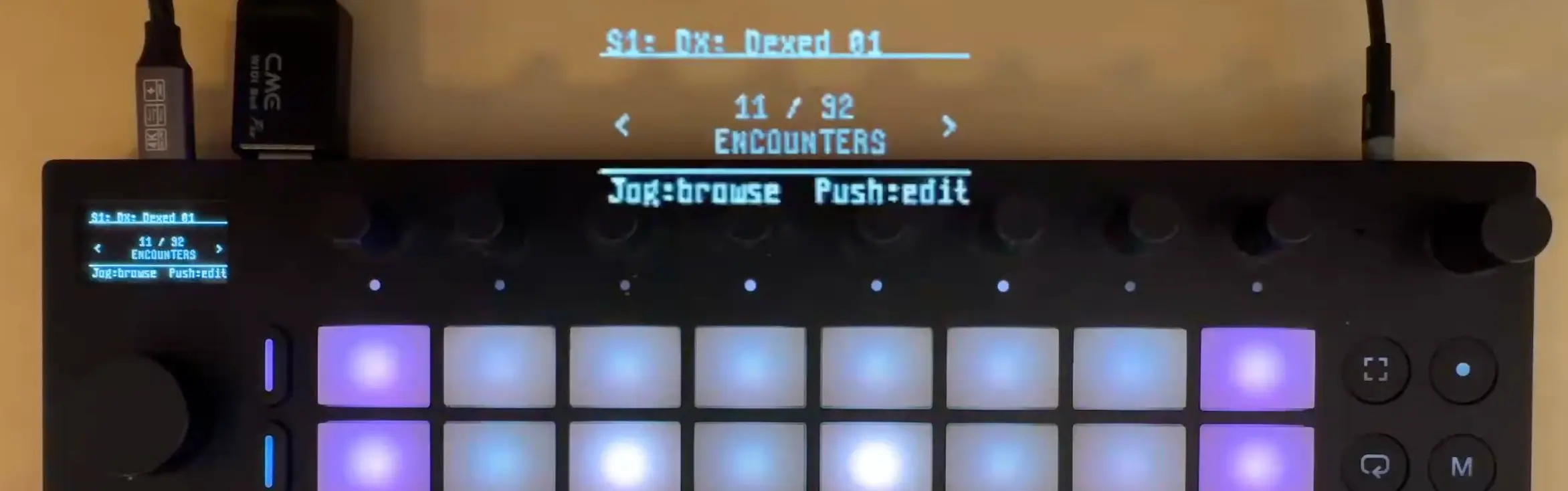
Schwung Modules galore
The framework comes with a growing catalog of modules, and installing new ones is straightforward once set up:
- Connect your Move to Wi-Fi and your computer.
- Download the cross-platform installer from the releases page.
- Follow the guided setup to enable SSH, install the framework, and pick modules from the store (it handles soundfonts, presets, ROMs automatically).
There you go! You can now access Shadow UI shortcuts (like Shift + Vol + Track for custom chains), layer effects on stock sounds, or dive into overtake modes for deep control. If you wish, check out this quick install walkthrough here or community demos on YouTube.
Since I find this framework super useful, I've seen producers share workflows like resampling everything through custom FX chains or using Super Arp with emulated classics for generative jams.
You can find the main project and installer here:
To fit within the Shadow UI, modules are designed modularly, many are ports of opensource classics or fresh builds. The catalog keeps growing (recent additions include song mode, on-device stems, time-stretching). Start with popular ones like Mutable Braids for wild textures or Dexed for vintage FM vibes, they're where you'll find the most inspiring and unexpected sounds.
How the hack actually works
At its core, Move's Schwung is a clever parallel overlay rather than a full firmware replacement.
Ableton Move runs on a Raspberry Pi Compute Module inside a custom Linux OS. The hack uses the device's built-in developer SSH access to install a lightweight framework that launches a "Shadow UI", essentially a secondary interface layer that runs alongside (and interacts with) the official stock UI.
Custom modules hook into the hardware (pads, encoders, screen, audio I/O, MIDI) via reverse-engineered APIs, processing audio/MIDI in user space without patching the main binary. This means stock features stay fully functional, shortcuts toggle between layers instantly, and everything coexists peacefully, no reboots, no risk of corrupting the official system.
It's duct-tape brilliant, community-driven, and designed to be modular so anyone can build/add new tools.
I really hope the Ableton won't close the 'hole' and will properly welcome the open-source community. For example, I’ve always been interested in custom MIDI controllers that could, for instance, send variable SYSEX just by turning a knob, but I haven’t found a convincing commercial product, up to now...
If you want to support my blog, you can buy them using the affiliate links below 👍
Have fun and I wish you lots of creativity!


Speak your mind