


You have a great 8-bar loop. It sounds good. But when you try to turn it into a full track, you stare at the empty timeline and nothing happens. This is the loop-to-song gap and it's where most producers stall forever. The problem isn't your loop. The problem is that you're trying to invent an arrangement from nothing, instead of using a map that already works.
In short:
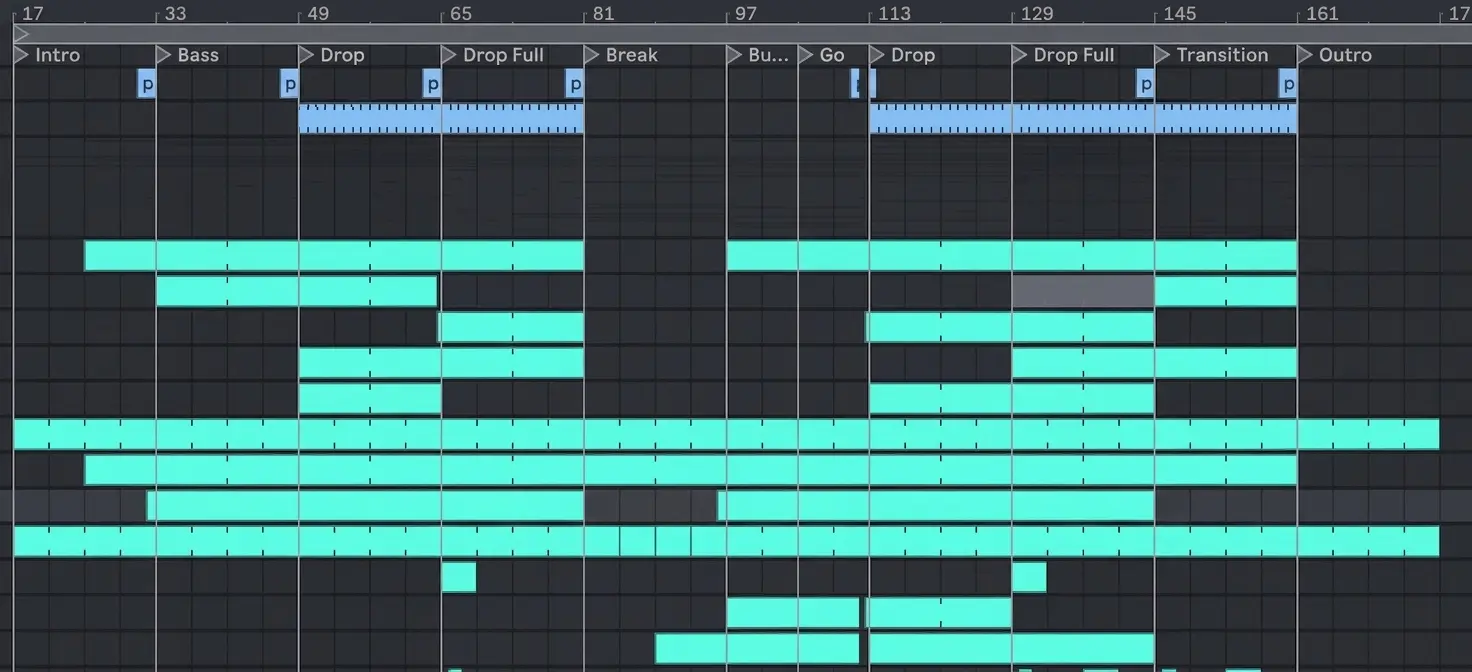
- Map a reference track: Import a song you love into Ableton and use arrangement markers (Ctrl+Shift+M) to label every section change - Intro, Verse, Chorus, Bridge, Outro - directly on your timeline.
- Follow the blueprint, don't invent: Don't arrange by feeling. Use the reference track's structure as your skeleton. If the reference has a 16-bar verse, your verse is 16 bars. If the chorus hits at bar 33, your chorus hits at bar 33.
- Subtract, don't add: Your main loop is the chorus. Remove elements for verses, strip further for the intro, and reintroduce everything with extra energy for the choruses. Arrangement is about what you take away, not what you pile on.
The reason you can't finish tracks isn't a lack of creativity, it's a lack of structure. When you arrange from scratch, every bar is a decision: "Should the synth come in now? Is it time for the chorus? How long should this verse be?" These decisions pile up and paralyze you. Meanwhile, the songs you love already solved this problem. Their structures work because they've been refined through decades of musical convention. You don't need to reinvent the wheel, you need to trace it.
Here's everything you need to know about using a reference track to go from loop to finished song, tonight!
💡 Tip: If you tend to overthink arrangement, set a 30-minute timer and map your reference track first. The structure comes before sound design tweaks.
Mapping your reference track
The first step is to import the song you want to use as your structural guide:

- Drag the audio file of your reference track into a new audio track in Ableton
- Listen through the song and place arrangement markers at every section change using Ctrl+Shift+M (or right-click the timeline > Add Locator)
- Name each marker: Intro, Verse 1, Chorus 1, Verse 2, Chorus 2, Bridge, Chorus 3, Outro. Be as specific as you want
- Note the bar numbers: how long is the intro? How many bars before the first chorus? This is the skeleton you'll follow
The reference track stays on its own audio track. Mute it when you're writing, unmute it when you need to check where you are in the arrangement. It's your map, not your destination.
From loop to song: the subtraction method
Now here's the key insight: your main loop is the chorus. It's the moment where everything plays at full energy. The rest of the song is built by taking things away, not by adding more.
- Chorus = your full loop. All four tracks (Drums, Bass, Synth, FX) playing together. Maximum energy.
- Verse = subtract. Remove the synth. Keep bass and drums. Maybe add a simple melodic element or a different hi-hat pattern. The verse breathes because it has fewer things happening.
- Intro = strip even further. Filtered drums, a pad, maybe just the bass line fading in. You're setting the mood. Less is more.
- Pre-chorus = build tension. Add one element back (the synth fading in, a riser on the FX track, a snare roll). You're telling the listener: something is about to drop.
- Bridge = change the texture. Swap the drums for a breakbeat, shift the synth to a different register, strip the bass. The bridge is a departure and it makes the final chorus hit harder when everything returns.
- Outro = subtract again. Remove elements one by one until the track fades to silence or cuts on a downbeat.
💡 Tip: If a section feels weak, remove one more element before adding a new one. Contrast usually makes the next section hit harder.
The beauty of this method is that you never compose from zero. You already have your chorus: the loop you love. Every other section is just that loop with pieces removed or slightly altered. No blank-page anxiety, no "what do I write now?" paralysis.
Common song structures: the alphabet of arrangement
Once you start mapping reference tracks, you'll notice that most songs follow a handful of repeatable patterns. Musicians use a simple letter system to describe these patterns: each letter represents a distinct section. A is typically the verse, B is the chorus, and C is a bridge, breakdown, or any section that sounds different from both A and B. With just three letters, you can describe almost any song ever written.
Here are the most common structures you'll encounter and the ones most likely to show up in your reference tracks:
- ABAB : Verse, Chorus, Verse, Chorus. The simplest and most universal pop structure. It alternates tension and release without any detour. You'll find it everywhere from The Beatles to Billie Eilish. Perfect when your hook is strong enough to carry the whole song.
- AABB : Verse, Verse, Chorus, Chorus. A folk and country standard that tells a full story across two verses before delivering the hook twice. The double verse builds narrative, the double chorus pays it off. Think Johnny Cash or early Bob Dylan.
- ABC ABC : Verse, Chorus, Bridge, Verse, Chorus, Bridge. Common in jazz, progressive rock, and sophisticated pop. Every third section is a departure, which keeps the listener engaged without abandoning familiarity. The bridge can be a breakdown, a key change, or a completely different texture.
- ABABCAB : Verse, Chorus, Bridge, Verse, Chorus, Bridge (as outro). This is the modern pop and EDM gold standard. Max Martin hits, dance tracks with a breakdown, radio-friendly everything, this structure delivers variety, a clear peak, and a satisfying resolution. If you're making electronic music, this is probably your default map.
- AAAB : Verse, Verse, Verse, Chorus. Sometimes called the hymn structure. Common in blues and gospel, where the emotional payoff lands only once but when it does, it hits hard. The three verses build tension that a single chorus releases all at once.
- ABACABA : Every section is unique. No repetition, all forward motion. Used in progressive rock, classical music, and ambitious electronic productions. This is the hardest structure to pull off because you're never giving the listener a safe harbor, but it can create a sense of continuous discovery that no other pattern can.
When you label your arrangement markers with letters instead of full names, you'll instantly see the shape of your song. A timeline that reads A - B - A - B - C - A - B is immediately easier to navigate than one that says Verse - Chorus - Verse - Chorus - Bridge - Verse - Chorus. The letters strip away the words and show you the architecture.
Try this: after placing your markers on the reference track, go back and add a letter to each one. You'll quickly spot which structure the song uses and you can use that same letter pattern as the skeleton for your own track.
💡 If, like me, your goal is to perform live, you can do the same thing in Ableton Live in Session mode. Each scene represents a section of your track. In the ABACABA example, you will have 7 scenes, and you can automatically chain the scenes using Scene Follow Actions.
Why this works
You're not copying the reference track's music, you're borrowing its timing and energy curve. The reference tells you when things should happen. The subtraction method tells you how to make them happen with the material you already have.
This approach eliminates the two biggest arrangement killers:
- Decision paralysis : you're not choosing what happens next, the reference already decided that. You're just executing.
- Perfectionism : you're not trying to create a "perfect" arrangement from taste alone. You're following a proven structure and focusing your creative energy on the music itself, not the scaffolding.
After doing this a few times, you'll start internalizing common structures. You'll know that a typical EDM track has a 8 or 16-bar intro, an 8-bar breakdown, and a 16-bar drop, not because you memorized it, but because you've built it. Eventually you won't need the reference anymore. But by then, you'll have finished a dozen tracks instead of a dozen loops.
💡 Tip: Don't study too many structures at once. Copy one reference structure fully, finish one track, then compare it with another.
Conclusion
The difference between a producer who finishes tracks and a producer who doesn't isn't talent, it's process. Importing a reference track and mapping its structure with markers takes five minutes. The subtraction method takes your existing loop and turns it into a full arrangement without requiring you to invent anything. You're not cheating, you're learning the language of song structure, one track at a time.
If you try this method and finish a track tonight, share it in the comments 😉
⭐ Not sure where to focus? Test your Ableton level in 5 min.


Speak your mind