


Most producers try to fix muddy mixes with EQ, compression, and sidechain, then wonder why nothing cleans up. The real problem started earlier. If your arrangement crowds the low end with three competing elements, no amount of mixing will save it. The four-bucket rule is a way to think about frequency space during production.
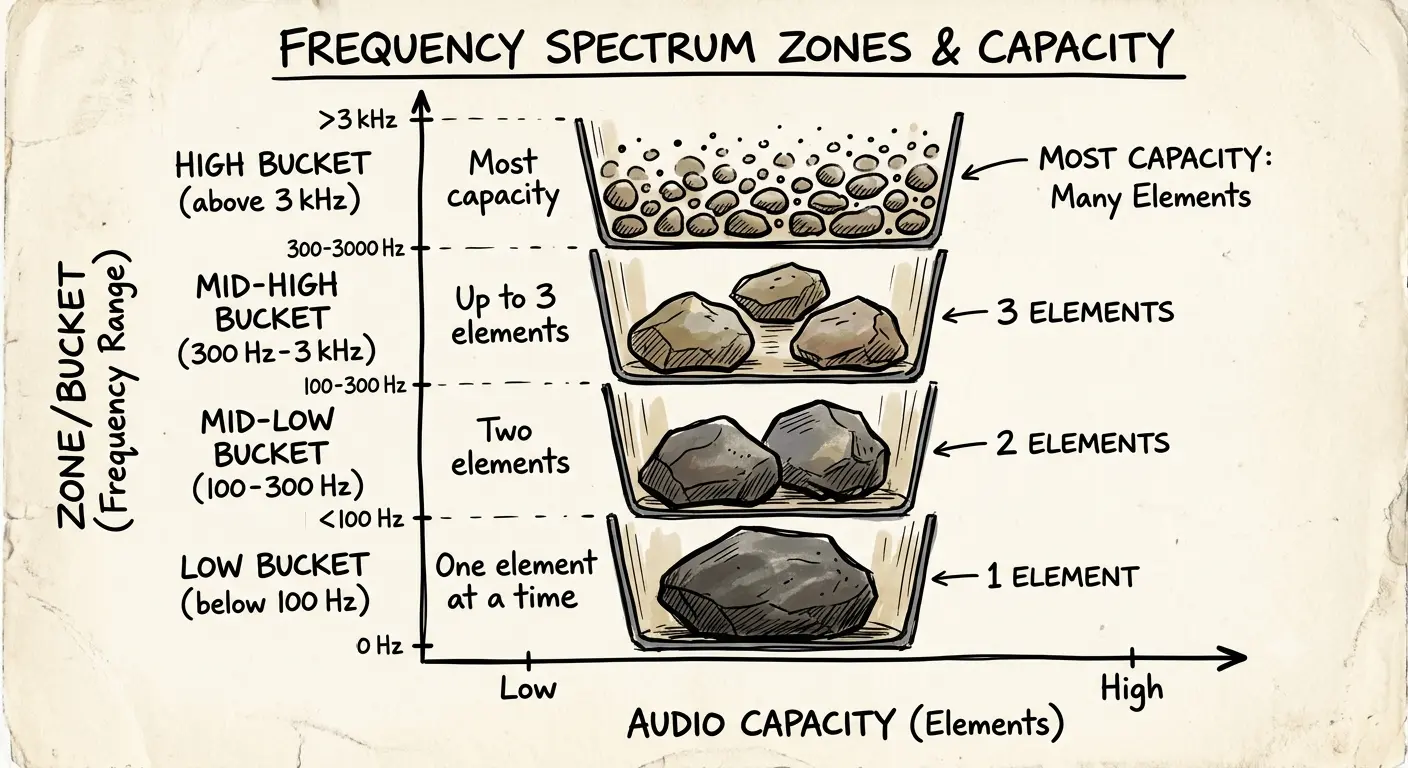
The low bucket holds one element at a time, the mid-low holds up to two, the mid-high holds up to three, and the high bucket has room for more. These are ceilings, not quotas. If you make minimal techno and your mid-high only needs one element, that's perfect. The buckets tell you where the line is, not that you have to reach it. Stay under these limits while you're writing, and mixing becomes almost straightforward.
The split points in this framework (below 100 Hz, 100-300 Hz, 300 Hz-3 kHz, above 3 kHz) are one choice among many. Some producers work with three buckets, others with five or six. The boundaries shift depending on genre, personal preference, and what the track needs. What matters isn't the exact frequency ranges. It's the principle: divide the spectrum into zones, limit how many elements sit in each, and make those decisions during production, not after. The numbers here are the ones that work best for most electronic music, but feel free to adjust them to your own style.
In short:
- Low Bucket (below 100 Hz): one element at a time. Only one sound should carry sub frequencies at any moment. Sounds can share the bucket if they don't hit simultaneously. Sidechain carves the window when overlap is unavoidable, but writing parts that alternate is the cleaner move.
- Mid-Low Bucket (100-300 Hz): two elements max. This is where kick body, bass warmth, and synth low mids live. Two is already pushing it. Any more and the mix gets muddy fast. One is often enough.
- Mid-High Bucket (300 Hz-3 kHz): up to 3, rare 5. Three elements can coexist comfortably. Fewer is fine. Five is possible if their timbres are very different. Any more and clarity dissolves, no matter how much you EQ.
- High Bucket (above 3 kHz): most capacity, still intentional. No strict count, but every element needs a distinct rhythmic or tonal role. The risk isn't frequency masking. It's hiss clutter.
The reason mixes sound unclear is rarely a plugin problem. It's an arrangement problem. Every element you add occupies frequency space, and that space is finite. When two or three sounds fight for the same range, they don't blend. They blur. The listener hears a wall of indistinct low end or a congested mid range, and no amount of EQ wizardry untangles what was never supposed to overlap in the first place.
The bucket framework turns mixing into a production decision. Instead of asking "how do I EQ these three bass layers so they fit?" you ask "do I need three bass layers?" The answer is almost always no.
Here's how to think about each bucket, and how to apply the rule while you're writing.
The Low Bucket: one element at a time (below 100 Hz)
Frequencies here are long, wide, and they interact destructively with each other. Two sounds occupying the same sub range at the same moment don't add up to something fuller. They cancel and smear. The result is bass that sounds loud on a meter but feels weak and undefined in the track.
The rule: at any given moment, only one element should own the sub range. That usually means your kick or your bass, not both with equal weight hitting at the same time.
Notice the phrasing: one element at a time, not one element total. A kick and a bass can absolutely share the low bucket as long as they don't occupy it simultaneously. When the kick hits, the bass can dip. When the bass sustains, the kick can be silent. This is why sidechain compression is useful: it carves a brief window for the kick by ducking the bass, so the low end is never crowded.
But sidechain is the safety net, not the default plan. The cleaner approach is to write your parts so they alternate naturally: stagger the rhythm, offset the note placements, or let one element rest while the other plays. When the arrangement itself keeps the low bucket clear, sidechain becomes a subtle polish rather than a salvage operation.
Common traps:
- Layered bass patches. Two or three synths all generating sub content at the same time. Pick one for the sub and high-pass the rest.
- Kick and bass on the same downbeat with no rhythmic offset. Sidechain can help here, but consider shifting the bass note slightly or choosing a kick that sits above the sub.
- Sub bass with long release. A sustained sub that overlaps into the next kick hit fills the low bucket from below. Shorten the release or shape the envelope so the sub decays before the next hit lands.
- Reverb and FX tails in the sub range. A long reverb on a bass sound fills the gaps between notes with low-frequency smear. Use a high-pass on the reverb return.
Making the low bucket decision early means you never have to fight for clarity later. One anchor at a time, no contest.
The Mid-Low Bucket: two elements max (100-300 Hz)
The mid-low range is where the body and warmth of your track lives. Kick thump, bass overtones, synth warmth, low guitar, the chest resonance in vocals. It feels like there's more room here than in the sub, and there is, but not much more.

The rule: two elements in the mid-low at the same time is the ceiling. One is often enough. This range is where "muddy" happens. Every sound with any low-mid energy gravitates here, and the accumulation is sneaky. A bass with harmonics at 120 Hz, a kick with its thump at 100 Hz, a synth with warmth at 200 Hz, and suddenly you have three elements stacking into a range that only has room for two.
The key to this bucket is separation through arrangement and octave choice, not EQ. If your kick's body sits at 150 Hz and your bass warmth fills the same zone, no amount of EQ cutting will make both sound full. One of them needs to move. Either choose a kick with a different fundamental, shift the bass up an octave in that section, or let one sit out while the other plays.
Common traps:
- Kick body plus bass warmth plus synth low mids. Three elements in the mid-low is the most common cause of a muddy mix. The fix is almost always removing one, not EQing it.
- Percussion with hidden lows. Toms and rimshots carry energy well into this range. A floor tom at 120 Hz plus a bass at 100 Hz is already a collision. High-pass the tom or mute it during the bass phrase.
- Pads that extend down. Many synth pads have significant content from 100 Hz upward. They seem harmless because they're quiet, but they fill this bucket with sustained energy that leaves no gap for anything else. High-pass the pad to 200 Hz or higher if you already have kick and bass occupying the mid-low.
The Mid-High Bucket: 3 target, 5 ceiling (300 Hz-3 kHz)
The mid-high range is where most of the musical information lives. Vocals, lead melodies, chord tones, guitar presence, snare snap. It's also where the ear is most sensitive, which means congestion here is instantly audible.

The rule: three mid-high elements at the same time is a comfortable maximum. Five is the absolute ceiling, and only if their timbres are very different. You don't need to fill every bucket. A minimal techno track might have a single lead in the mid-high and nothing else, and that's exactly right. The numbers are limits, not goals. Beyond the limit, clarity starts dissolving no matter how you EQ.
This doesn't mean your track can only have three sounds total. It means you should be intentional about when each element is active:
- Let elements take turns. If a lead plays during the chorus, the pad can drop an octave or simplify its pattern. Arrangement is about stepping back so something else can step forward.
- Choose sounds with different timbral profiles. A warm pad, a bright pluck, and a vocal can share the mid-high because they occupy different parts of it. Two saw leads in the same octave? That's already one too many.
- Octave placement matters more than EQ. Moving a synth up or down an octave during production avoids overlap entirely. You'll never need to carve space with EQ if the sounds weren't competing to begin with.
Why three? The mid-high has more room than the lows, but the ear parses it critically. Three distinct elements with different timbres is about what most listeners can separate without effort. You can absolutely work with fewer. A kick, a bass, and one percussive lead is a complete arrangement that fills every bucket without crowding any of them. Push to four or five and you're relying on contrast. If the sounds are similar, the limit drops back to three fast. Past five, even different-sounding elements start competing for attention, and the result is a mix that feels busy but unclear.
Think of it like a conversation. Three people with different voices can talk and you can follow each one. Add two more and it becomes noise, unless one of them is whispering, another is shouting across the room, and a third is only speaking every few seconds. Timbre and activity level matter as much as the count.
Common traps:
- Two leads in the same octave. They don't blend. They fight. Change one's octave or mute it during the other's phrase.
- Thick pads underneath everything. Pads are mid-range magnets. They fill the entire spectrum gently, which makes them hospitable to overlap with almost anything. Use them sparingly, or filter them down to a narrower band.
- Vocal plus vocal plus vocal. Double-tracked vocals, harmonies, and ad-libs all occupy mid-high. If you have a lead vocal, a harmony, and a pad playing simultaneously, you're already at three. Choose what matters most in each section.
The High Bucket: most capacity, still intentional (above 3 kHz)
Above 3 kHz, the frequency spectrum opens up. Hi-hats, rides, shakers, cymbals, air, reverb and delay tails, noise layers, FX: this range can accommodate more elements because the wavelengths are short and the ear tolerates more density.

There's no strict number for the high bucket. You might have five, six, even eight high-frequency elements in a track and still have clarity. The reason the highs are more forgiving:
- Short wavelengths. Two high-frequency sounds at 8 kHz are easier for the ear to separate than two mid-range sounds at 400 Hz, even if they overlap in frequency.
- Transient, not sustained. Most high-frequency elements are percussive (hi-hats, shakers, rides), which means they don't occupy continuous space. A closed hi-hat on every eighth note and an open hi-hat on the off-beats don't fight each other because they're not ringing at the same time.
- Different roles. A ride cymbal, a shaker, and a layered noise sweep serve different musical functions. The ear can separate them even when they overlap in frequency because their patterns and textures are distinct.
But the highs still have a breaking point, and it's different from what happens in the lows and mids. The risk isn't frequency masking. It's hiss clutter. When too many high-frequency elements play at once and none has a distinct identity, they fuse into undifferentiated noise. The mix sounds bright but undefined, like static layered on static.
The discipline for the high bucket is simpler than counting: every element needs a reason to be there and a role the ear can identify. A hi-hat defines the groove. A ride cymbal adds width and movement. A noise sweep builds energy into a drop. If you can't name what a high-frequency element contributes, it's probably just adding clutter.
Common traps:
- Three similar hi-hats. Two closed hats and one open hat with slightly different tunings isn't layering. It's blurring. Pick one or two and shape them intentionally.
- Reverb and delay tails piling up. Each send adds high-frequency content. If every track has a long, bright reverb tail, the highs fill with wash that competes with your percussion.
- FX that serve no rhythmic or textural role. A riser into the drop serves a purpose. A background hiss that's "just there" doesn't.
Making production decisions early
The bucket rule is most powerful when you apply it before you start mixing. Here's how to build it into your workflow:
Start with the low bucket. Choose your anchor (kick or bass) and commit. Write the part, choose the sound, and make sure nothing else is generating sub content at the same time. Every other low-end element gets high-passed or replaced. If two sounds need the sub range, make sure they alternate in time. Let the arrangement do the work before you reach for sidechain.
Check the mid-low. You should have at most two elements with significant energy between 80 and 300 Hz. One is perfectly fine. Typically that's your kick body and your bass warmth. If a synth pad or percussion element is also sitting here, high-pass it or mute it during busy moments.
Fill the mid-high next. Add your harmonic and melodic content, but stay under three simultaneous elements in the same register unless their timbres are genuinely different. If you want a fourth or fifth, check that contrast first, then ask whether one of the first three can sit out or move to a different octave. Arrangement means knowing when to step back. You don't need three elements here. One or two is fine if the music calls for it.
Use the high bucket for definition. Add percussion, FX, and air after the core is in place. These elements should complement what's already there, not compensate for what's missing. Every high-frequency element should have a clear job: groove, movement, or transition.
Listen in mono. Collapse your mix to mono periodically while producing. If elements disappear or turn to mush, they're overlapping in the same bucket. That's your signal to cut, move, or mute, not to reach for an EQ.
Count your elements per bucket. At any point in the arrangement, count how many sounds are active in each range. Low: one at a time. Mid-low: one or two max. Mid-high: three is the ceiling, fewer is fine. High: no strict count, but every element should have an identifiable role. If the numbers don't fit, the fix is an arrangement decision, not a mixing one.
Conclusion
A clear mix is not the result of better EQ settings or smarter compression. It's the result of an arrangement where nothing fights for space in the first place. The four-bucket rule gives you a simple framework: one element at a time in the lows, up to two in the mid-low, up to three in the mid-high, and intentional choices in the highs. These are maximums, not minimums. Less is always fine. Follow the limits while you're writing, not after you finish, and mixing stops being a salvage operation and becomes what it should be: small adjustments to something that already works.
If you apply the bucket rule in your next session, share your results in the comments 😉
⭐ Not sure where to focus? Test your Ableton level in 5 min.


Speak your mind